Irish Water : time to flush it away, refill later..
Thoroughly logical assessment, resolution and recommendation by Prof. Brian M Lucey.

Home » Uncategorized (Page 3)
Irish Water : time to flush it away, refill later..
Thoroughly logical assessment, resolution and recommendation by Prof. Brian M Lucey.
Here’s a REALISTIC take on The economic side of Budget 2015 projections:
Your honest response is invited Minister S Harris, TD?
Gross current expenditure for 2015 will be just over €50 billion. This figure represents an increase of €429 million over the 2014 Revised Estimates.
Note: in H1 2014, Government spent €35.567 billion which is €1.255 billion more than in the same period 2013.
As unemployment fell, social benefits rose from €13.823 billion to €14.016 billion. General Government Deficit has fallen only €307 million year on year in H1 2014.
THESE FUGUES ARE NOT CONSISTENT WITH A STRONG ECONOMY OR A STRONG POSITIVE FISCAL PERFORMANCE.
Meanwhile, the state took out of the economy €1.893 billion more in taxes and social contributions in H1 2014 compared to H1 2013. Where did this increase of funding go?
Government deficit target for 2015 is 2.7% of GDP under ESA 2010 classification. This means that going back to Troika programmes-comparable measure (ESA 1995 classification), the target deficit is closer to 3.2% of GDP. This is ahead of 3% target and shows how much debt we owe not to GOOD MANAGEMENT OF RESOURCES, but to accounting rules changes.
Here’s a set of economic puzzles courtesy of the Department of Finance:
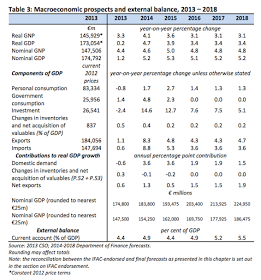
Real growth is slowing down from 2014 levels, but employment generation is rising.
A puzzle?
Especially as domestic demand is expected to grow at same rate in 2015 and growth rate is expected to fall in years after.
As compared against other organisations forecasts:
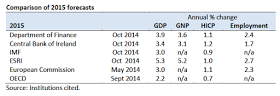
Added puzzle:
IMF projections for Irish economy real GDP growth are:-
2015 3.045% – full 0.85 percentage points lower than DofF, 2016: 2.538% which is full 0.87 percentage points below DofF, in 2017 : 2.649% or 0.75 percentage points below DofF… and so on.
And another blatant kick in the teeth… the promise of fiscal rectitude and ‘no going back to boom-and-bust cycles’:

All of the above is rather academic, since the Department of Finance refuses to forecast Gross Voted Current expenditure of the Exchequer beyond 2015, setting all of it at €50.075 billion for each year 2015-2018.
This means the estimated effects on deficit and on borrowing are based on assuming zero growth in spending and continued growth in tax revenues.
Happy times roll on, even though Haddington Road agreement is about to expire.
Still, as you can see, debt/GDP ratio is expected to fall, courtesy of higher GDP, including the new classification effects that came into force this year.
Debt itself is not expected to fall.
Instead, from €203.2 billion, Government debt is expected to rise to &215 billion in 2017 and basically stay there in 2018.
We will be BACK TO SEVERE AUSTERITY AFTER NEXT GENERAL ELECTION, if party politics system prevails in the election.
>>>MARK MY WORDS<<<
On balance: a bit too much optimism, especially past 2015.
Not enough risk cushion.
THE NUMBERS DON'T ADD UP.
You are not being honest and truthful with the sovereign, which is a SACKING offense!
Public admission with car: €2. FREE Without Car.
NO PRE-BOOKING required, just turn up and pay on site.
Excellent tarmac surface.
Refreshments/Catering: YES. Fatimas Kitchen
Toilets: Sourcing
Car Boot Sale Maynooth.
This Month we have some surprises!
Depending on the turnout, best turned out stall by a Vendor will receive a special award. One and possibly two buyers will also receive a special award.
http://www.maynoothkilcocklionsclub.org/car-boot-sale-maynooth.html
There is an unhealthy anarchy in Ireland overseen by criminals in many spheres of society.
New York, once riddled with crime is a much safer place.
We are no longer able to live peaceably and in safety in Éireann.
It is a wonder that major commercial interests and industries decide to locate in Ireland, based alone on security considerations.
Let the good honest hardworking citizen unintentionally fall short, even for something of a summary nature the full rigours of the law is brought to bear. It is different for the known gouger, knacker, criminal hobo persons who engages in serious crime. Everybody is afraid to deal with their ilk because they know that there will be serious sometimes fatalistic retaliations.
We don’t have a proper policing service because it’s direction has been hijacked by government. The police service has been taken over and is now in the total control of political interests. We have the best rank and file policemen and police-women in the world. They however lack proper direction, resources motivation and respect. Their will and spirit has been broken. They however do have the support of the vast majority of the ordinary people, though that is not sufficient to allow the police service conduct it’s business lawfully. There is a major breakdown in police morale. Many have been killed and seriously injured. If they do their job a complaint is made and it takes precedence in the hands of the Garda Ombudsman Commission, a totally unnecessary over the top highly paid and financed usurper organisation. There were never full and proper grounds for its establishment, other than as a junket-ridden quango. Moreover, there is much more justifiable reason that the legal profession should have a similar stronger oversight body. A strong oversight body is most necessary to try curbing the massive doubts and mistrust that is very palpable in the legal and judicial professions.
GSOC should be abolished forthwith.
Politicians have done all in their power to negate the effectiveness of the police service so that they have no obstacles to their nefarious self-interests. They effectively silenced the Garda Commissioner in legislation introduced in 2005.
Difficult to understand how the Garda Commissioner, heading the lead investigation service in the state was never asked for any real evidence by the so-called learned people of the very costly lengthy planning tribunal inquiry that went on in Ireland for sixteen (16) years plus. Nothing worthwhile ever came out of it other than legal people becoming filthy rich with massive amounts of money in the form of fees. The Police service would be disbanded for such a lengthy, costly, useless inquiry.
Police personnel readily give life and limb in the service of their nation yet the legal profession have hijacked, as a cash cow the lengthy meager compensation process that is in place to compensate. The legal profession are awarded about half the amount, and some years much more than half that awarded to long-suffering appellants. The legal profession fiscal take has grown steadily since inception. While the Judge presently cites the fiscal problems of the country in lessening awards to appellants, she increases the costs paid to the legal profession on both sides and also administrative costs. Many senior counsel never even study the file before the morning of the court, as has been evidenced. Such incidents of gross negligence and misrepresentation are simply laughed off by the Judge. The Garda Siochana Compensation scheme is unfit for purpose and ancient, dating back to the forties. Full of complete treachery overseen by the High Court. Evidence supporting the Minister for Finance and the state is allowed from the same group of experts in the various fields who readily tell lies on behalf of the state to counter claims. A massive growth in additional administrative fees has consequently grown in addition to legal costs.
In 2011 €6 million was awarded to appellants. €3.25 million was paid in legal fees and a further €1 million was paid in administrative fees. They are making hay as quickly as they can because they know that their abuse of the system for personal gain is coming to an end. A national disgrace and a complete insult to afflicted members of An Garda Siochana and their suffering families. Some have lost their homes and all of their savings because of the delays, not to mention their sanity.
It is sad that we have such an excellent policing talent and commitment in An Garda Siochana when one considers that there is no provision in the Irish constitution for a police service or even mention of An Garda Siochana.
We are going nowhere as a nation. Criminals and self-interested politicians and their cronies rule the roost in Ireland. This will only be stopped by another civil war. It is a pagan land without saints or scholars.
Ireland has no rightful place among the politically evolved post-WWII nations of Western Europe because it’s government of the day cowered away and chickened out of its responsibilities with a deceitful preference that Hitler might win.
Lucinda Creighton has warned that Irish political life is being destroyed by what she called “a deathly culture of brutal pragmatism”.
What can we now expect?
Even if you work with an experienced online marketing team, there are times when you’re bound to have to do a bit of copywriting yourself. Even the busiest business owners and executives get tasked with the occasional tweet, article, or email, and it pays to be able to convey key messages in a succinct way.
With that in mind, we’d like to share with you seven tips for world-class copywriting that virtually anyone can use:
1. Write with a single person in mind.
Use marketing personas for this exact reason. The more you can picture your perfect client in your mind’s eye, and write something that appeals directly to her/him, the easier it’s going to be to create a one-on-one marketing effect (your goal).
2. Say what you mean, as clearly as possible.
Where a lot of business people trip up is trying to think like professional writers, when they should simply communicate clearly. When in doubt, use a simpler word instead of a more complex one. Aiming too high with your language doesn’t always make you look smarter; It can just as easily come across as jargon. May sound like you are talking down.
3. Support your key statements.
If you are making a claim that flies in the face of common sense, or accepted wisdom, try to back it up with something credible. Often, a statistic or case study will do. However, if those aren’t available, a personal anecdote or testimonial from a customer can be helpful. There is a fine line between being unconventional and being out of touch, so support your strongest statements in the best ways possible.
4. Always end your writing on a strong point.
Every marketing communication you put together (with the possible exception of short tweets and personal notes,) should end with a definite conclusion, a call to action, or both. If at all possible, invite the reader to take the next step, or share an opinion. I practice this rule in every communication I write, from emails to staff or clients, to closing out my twice-weekly blog articles. Simple truth: if you don’t ask for a response, it’s less likely you’ll get one.
5. Write once and edit twice.
A lot of what people consider “writer’s block” is just a lack of momentum. For your first draft, just keep putting words together and trust you’ll find the ones you need. After you have a complete draft, edit twice. The first time for structure and organisation; and the second time to eliminate anything that isn’t needed to help tell your story or make your point.
6. Read the document out loud before you send it.
Most simple typos, grammatical errors, and structural problems that people struggle with can be fixed by simply reading the draft out loud. Take your time and don’t rush over the words. You’ll find that as much as 90% of the most common writing issues can be taken care of this way.
7. Never send or publish something you’ll have to take back later.
We live in a world where a single ill-advised email, blog post, or social media comment can lead to big problems. So, before you publish something to the Internet, or send it to any of your contacts (or especially, to all of them), think carefully about whether it’s an idea you really want to express, or a thought you may want to keep to yourself.
You don’t have to be a born writer to put together effective business communications, or add blog posts or social updates to your online marketing efforts. All it takes is a bit of focus and attention to detail… the rest just comes with practice.
Car Rental Worldwide. Fast Efficient Cost Effective Online Vehicle Hire Booking Service.
Buy F 1 Racing Tickets Online. Safe, Secure online purchasing. Delivery worldwide.
Win a Dream Super Car every Month. Supercar Competition. £14 million + worth of prizes
Tags: data collection, security, Facebook, Government, Little Brothers, Privacy, Social media, theft, state piracy,

YOU ARE BEING UNFAIRLY TAKEN ADVANTAGE OF BY THE BIGGEST HEIST IN HISTORY, THE ABSOLUTE INVASION OF YOUR PRIVACY AND THE LESSENING OF YOUR IDENTITY SECURITY.
Make them stop by refusing to co-operate. Boycott data thieves.
No matter what you are trying to buy, sell or source online NEVER okay your location or agree to readily giving access and personal information to most apps. It can readily be detrimental and come back to haunt you.
Only ever buy online via secure means – https//.
These thieves are given freedom to defraud because their nefarious ways are not questioned or legislated against by Internet savvy politicians and political parties who are buying and using the personal data harvested. They say it’s not illegal! The political influence is the reason it’s presently classified as not being illegal.
You probably have no idea how much of yourself you have given away on the internet, or how much it’s worth. Never mind Big Brother, the all-seeing state; the real menace online is the Little Brothers – the companies who suck up your personal data, repackage it, then sell it to the highest bidder. The Little Brothers are answerable to no one, and they are every-where.
What may seem innocuous, even worthless information – shopping, musical preferences, holiday destinations, flights, hotel reservations – is seized on by the digital scavengers who sift through cyberspace looking for information they can sell – a mobile phone number, a private email address.
The more respectable data-accumulating companies – Facebook, Google, Amazon, eBay, yahoo – already have all that. Even donating money to charity by texting a word to a number means you can end up on databases as a ‘giver’ and be inundated with phone calls from other noble causes. Once your details end up on a list, you can never quite control who will buy them.
As you surf the web, thousands of ‘third-party cookies’ track your browsing habits. Then there’s your smartphone, which can log information every waking and sleeping moment. Quintillions – yes that really is a number – of pieces of data are being generated by us and about us.
Look for example at Facebook. In a typical week, its users upload 20 billion + items of content, pictures, names, preferences, shopping habits and other tit-bits. All information that can be stored and later employed to help advertisers.
It is presently held as legal for companies to spy on us, and it is very lucrative. Some analysts estimate we’re each giving away up to £5,000 worth of data every year. A worldwide industry has emerged over the past decade that is dedicated to finding new ways of extracting and analysing this bounty. ‘Data brokers’ operate enormous clearing houses which buy, analyse and then sell online and offline data. One of the largest, Acxiom Corporation, is believed to hold information on about 500 million consumers around the world, and has annual sales of more than $1 billion. Many of the big social media companies, including Facebook, work closely with these data brokers – cross-referencing your status updates against postcodes or loyalty-card data from shops. From thousands of fragments, they can build a remarkably detailed picture of you.
They certainly won’t like my article! I’ll be keeping a sharp look out though.
A little further down the chain, companies are scooping up your tweets or Facebook posts, analysing them and selling on the results for a hefty fee. Recently Sony paid $200 million for a company that does exactly that. This doesn’t just affect exhibitionists on Facebook; if you’ve completed the electoral register, your home address is probably only a click away for anyone vaguely interested.
This harvested data can be used to figure out your probable location and logically guess at your consumer behaviour. In one infamous case, a US supermarket responded to a young female customer’s purchases by offering her vouchers for various pregnancy products. These were intercepted by an unsuspecting and very irate father. In another, a GPS service designed to help drivers find quick routes was also selling the information to the Dutch police, who could use it to work out who was breaking local speed limits. Each year, the Little Brothers get more clever.
This makes it easier than ever for companies – and even politicians – to pin you down with personalised and effective marketing, messages and offers. The UK Labour party has recently hired one of Barack Obama’s digital gurus, Matthew McGregor. Don’t be surprised to see creepy targeted ads from Dave, Ed and Nick at the next general election, based on some innocuous comment you might have made on your Facebook page about wind farms or Tory policy on pensions.
How worried should you be? Having slightly less irrelevant ads popping up on your screen hardly amounts to a sustained attack on your freedom. Data brokers can’t break down your door. And after all, when you join a social network or run a search on Google, it’s an exchange: you let people spy on you, and they give you a fulsome service for free.
NOTE; NB:
But this exchange is starting to become a bit one-sided. Every time we download an internet app, we accept a lengthy list of terms and conditions. Unfortunately few of us really know what we’re signing up to – one recent survey found under half of us knew that mobile phone apps can collect and store personal data.
And those terms and conditions? They’re usually comprehensible only to a contract lawyer with a background in software engineering, but we click yes and hope for the best. The results were explained well in a recent documentary, Terms and Conditions May Apply. ‘ The greatest heist in history wasn’t about taking money,’ says the voice-over. ‘It was about taking your information- and you agreed to all of it.’
Agreement, in this case, means clicking ‘OK’ to the contracts that include all sorts of worrying, loosely worded clauses – and which it would take about a month of your life each year to read properly. But perhaps you should set that time aside. A British firm recently included a clause which asked for permission to ‘claim, now and for evermore, your immortal soul’ – a techie’s joke which harvested 7,000 souls in one day.
‘Hello, we’re trying to find somewhere we can smoke…’
When the hugely popular Instagram updated its user agreement to say that ‘a business… may pay us to display your photos… without any compensation to you’, uproar ensued, the clause was removed, and the company declared that it had never intended to sell on photos. But in order to opt out of data collection, or to object to nasty terms and conditions, you have to know exactly who’s collecting your data- and it’s hard to know where to start.
Civil liberties groups are increasingly concerned, because they realise that companies, police and governments have a mutual interest in the gathering of personal data. Nick Pickles, head of Big Brother Watch, says large-scale commercial data collection is a ‘dream come true’ for governments because it dramatically extends the possibility for surveillance. Intelligence agencies don’t need to spy on you any more; they can simply go to the relevant internet companies and prise out of them what they need.
All this data is also a goldmine for fraudsters. Identity theft is increasing, which is no surprise seeing how much information people post about themselves online. Often we’re complicit. In saying where we are on our social media accounts, we also say where we are not. The website pleaserobme.com is a joke – but it has a serious point behind it, a rather brutal reminder of the dangers of location-sharing online.
The internet, of course, is just getting started. More and more everyday objects are being fitted with microchips: fridges, keys, wallets, cars. And even hair: Sony recently filed a patent for a SmartWig that could take photos and vibrate when you receive a message. Google’s augmented reality glasses will be able to record what and who you’re seeing. On a more mundane level, smart energy meters which can record your energy consumption patterns will be installed in every home by 2020. As it stands, no one really knows who will own all this information, and how will it be regulated.
The public is getting worried. So what should we do? The past six months have seen a flurry of ‘crypto–parties’ – free workshops to learn about how to protect your privacy online. (I attended a packed event recently.) Anonymous browsers like ‘TOR’, often used to access the ‘dark net’, are becoming more popular. The dark net is usually referred to as an online underworld where drugs, pornography and worse are bought and sold – but it’s also one of the few places you can go to escape Brothers Little and Big. Even Facebook users who were once happy to share everything are tightening their privacy settings.
Here is another danger. It’s right that people should be able to keep things private, but the vitality of the internet depends on people sharing information: that was the whole point of the net when it began as an academic project in the late 1960s. The more you share, the more you receive. And there are many beneficial uses of data. Professor Nigel Shadbolt, director of the Open Data Institute, says that Google has been extremely successful at using search terms to understand how epidemics spread. Satnav technology is getting better at avoiding traffic jams, because of drivers agreeing to share their progress. (http://www.waze.com). Analysing our energy consumption patterns could cut down bills dramatically.
As a ComSec consultant, I am extra keen to make this a serious discipline. Professor Shadbolt thinks if we can analyse the use of social media while respecting privacy and consent, the benefits to society in general could be immensely important.
The digital revolution has transformed our lives, but the technology that does so much for us comes at an unfair cost. For good or ill, the internet has ravaged notions of privacy: It’s not really possible to get by in the modern world without sharing information about yourself. The question is how to control that.
The Germans already have a term, informationelle selbstbestimmung, which translates into knowing what data you have and being in control over how it’s used. In part, that means us wising up to exactly what data is being sucked out of us. It also requires companies to be transparent about what data they’re sucking – and how they’ll use it. At the moment it’s still too shadowy and confusing. Basic market competition should help. As the value of our personal information grows (and we become more aware of that value), companies that are open about what they’re using will have a significant advantage over competitors. The big players are already looking for ways to give users more control over their data: even Axciom has started to open up a little. It makes good business sense, and probably helps that some savvy politicians and quangos on both sides of the Atlantic are starting to pay more attention to this issue.
The Russian scene is brutal.
But it may be that we do not want the Little Brothers to stop watching us entirely – we’ve become dependent on the services they help to deliver so cheaply. One of the reasons firms like Amazon and Google have grown so huge is that they deliver services which billions of us want. The majority of Europeans now use Facebook, Twitter, Instagram or another social media accounts – none of which charge us a penny. As the saying goes: if you’re not paying, you’re the product.
In Ireland the government and revenue authorities have been holding back on an absolutely crucial postcode system for the country.
Though postal codes are a vital cog in online business and Internet marketing, which the Irish government strongly supports, zip codes are still not a reality some ten years after being first mooted. It now transpires the government are trying to link postcodes more to individuals than places in order to tie in taxation gathering more tightly and probably unjustly.
So there you are now. Don’t loose any sleep over it all but, try to be a little bit wiser!
Car Rental Worldwide. Fast Efficient Cost Effective Online Vehicle Hire Booking Service.
Buy F 1 Racing Tickets Online. Safe, Secure online purchasing. Delivery worldwide.
Win a Dream Super Car every Month. Supercar Competition. £14 million + worth of prizes
Tags: data collection, security, Facebook, Government, Little Brothers, Privacy, Social media, theft, state piracy,
Set up your virtual home button
The virtual home button is a feature built-in to Apple devices, such as the iPhone and iPad. It provides additional functionality and can act as a backup for the physical home button.
Follow the step-by-step guide below to activate your device’s virtual home button.
Step-by-step guide
Step 1
From the home screen, select Settings.
Step 2
Select General.
Step 3
Select Accessibility.
Step 4
Select AssistiveTouch,
then, slide the switch to ‘On’.
After a few seconds, the virtual home bottom will appear in the bottom right-hand corner of your screen.
Tapping the virtual home button gives you access to several features including basic phone functions, favourite tasks and gestures.
Step 5
To deactivate the virtual home button, follow this guide from the beginning, sliding the AssistiveTouch switch to ‘Off’ in Step 4.
Car Rental Worldwide. Fast Efficient Cost Effective Online Vehicle Hire Booking Service.
Buy F 1 Racing Tickets Online. Safe, Secure online purchasing. Delivery worldwide.
Win a Dream Super Car every Month. Supercar Competition. £14 million + worth of prizes
In keyword, algorithmic and analytical research, etc., surprising data can be thrown up in the hands of an expert, which I pursue to obtain great content.
Outcomes on existing information of a current nature can be surprising.
Future projections can be really frightening when democracy, legal, judicial and finance in Ireland are factored in.
God help us all. Austerity – We ain’t seen nothing yet!
Car Rental Worldwide. Fast Efficient Cost Effective Online Vehicle Hire Booking Service.
Buy F 1 Racing Tickets Online. Safe, Secure online purchasing. Delivery worldwide.
Win a Dream Super Car every Month. Supercar Competition. £14 million + worth of prizes
The presently topical, though somewhat gray public announcement on the proposed introduction of long awaited post codes in Ireland is a typically badly commissioned and explained blind, dumb state project comparable to the grave criminally inexcusable costly error made in purchasing electronic voting machines!
Politicians will never learn.
This issue is much different though in many respects, principal being the public already know, from practical experience that Loc8 cannot be bettered and simply should be utilised to generate postal codes / zip codes for Ireland. It is already sad and sorrowfully that it could have been introduced years ago and saved a lot of money.
The Minister, bullied and blinded by executives in An Post and their cronies is, through pure lies and misguided ignorance apparently unable to make an informed change.
An Post has a checkered history of ineptitude and a distinguished record of making a mess of things, over-spending and squandering state assets without recourse to sanction.
What has happened to our “Made in Ireland” “support Irish Made” motto.
There is time to see sense and change to something brilliant and Irish Made.
The people need to really make themselves heard on this issue.
The people are fools no longer.
The people are sovereign.
Please make this issue viral for the common good and the saving of millions in these times of such great austerity that is so badly affecting most people in Ireland.
Setup your free postal code in Ireland now. Don’t wait for An Post.
Setup your Loc8 postal code for free:-
 https://maps.google.com/maps/ms?msid=204771077306677250798.0004d82f542d6ac3a85b2&msa=0&ll=53.383284,-6.59479&spn=0.003808,0.012392
 arthurohara.com